Leukemogenesis studies with persistently activated forms of Stat5
Network Contribution
Leukemia derives from clonal variants that carry multiple genetic lesions and mutations can become dominant and transform to full disease. Such clones have increased repopulation capacity in competitive transplants, e.g. due to decreased cytokine dependence, often observed upon mutation of a tyrosine kinase. High pYStat5 is regarded as a general promoter of hematopoietic cancers, although normal Stat5 function safeguards hematopoiesis. The Jak2-Stat5 pathway drives several core cancer pathways but can also promote differentiation or senescence.
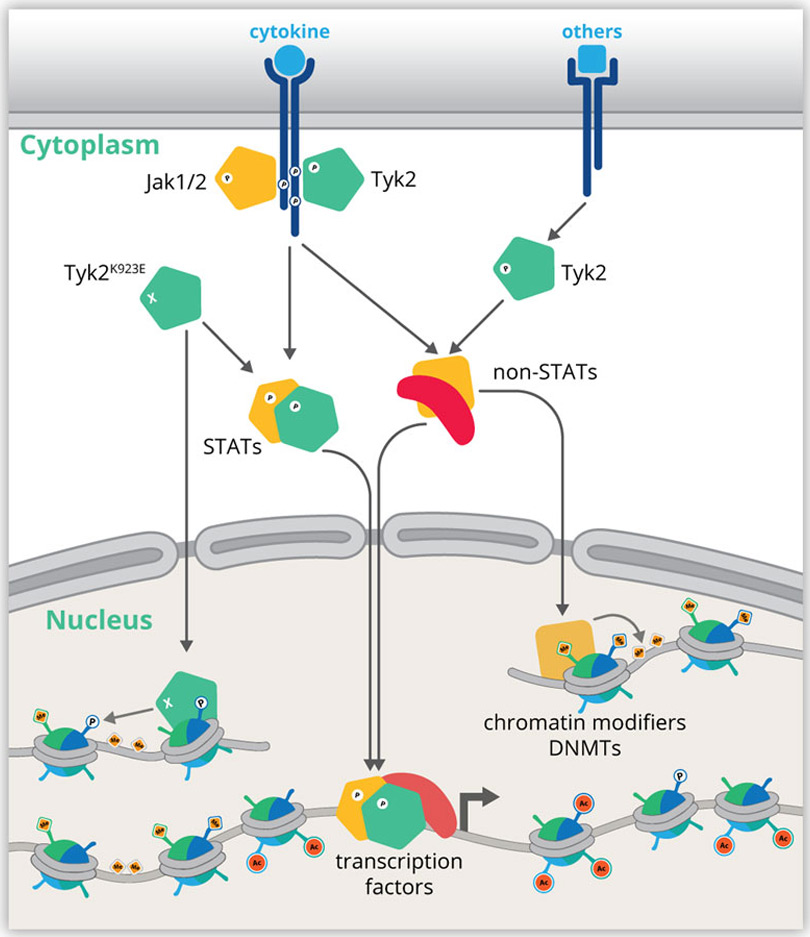
In SFB-P07RM we are studying signaling through the Jak2 kinase and Stat5 transcription factors in tumorigenesis. Exploiting new mouse models we are investigating hematopoietic cancer development in mice harboring Jak2 and Stat5 gain-of-function mutants combined with loss of tumor suppressor protein function. Both Jak2 and Stat5 activation (pYStat5) are hematopoietic cancer drivers. Together with SFB-P08MM we have developed three new gain-of-function Stat5a mouse models to provide reliable systems to study cancer. We are performing the research in close collaboration with SFB-P12RK to test tumor suppressor proteins that synergize with oncogenic Stat5 (cS5) and to profile them genetically. High or low cS5 activity is surprisingly well tolerated in hematopoietic cells and transgenic cS5 mice displayed no leukemia early in life.
The following two main hypotheses are central to the project part:
(1) Jak2-Stat5 signaling is only oncogenic if accompanied by loss of tumor suppressor proteins.
(2) Stat5 activity gradually increases in the clonal population upon disease progression.
To test both hypotheses we have developed three inducible transgenic lines with cS5 expression in hematopoietic lineages. First, we evaluated inducible cS5 expression using a BAC transgenic approach (called icS5 and described in the report). We found that cS5 induction did not cause neoplasia but we observed cooperativity with haploinsufficient PTEN loss. Next, we developed two transgenic mouse lines (in the following abbreviated as vcS5 mice) with high (vcS5
high) or low cS5 (vcS5
low) levels of activation. The expression of cS5 is restricted to hematopoietic cells and developmentally starts in the hematopoietic stem cell (HSC) stage. The first hypothesis will be tested by combining and creating compound mouse models with haploinsufficient loss of important tumor suppressor proteins (IKZF1, SOCS2, CUX1 or PTEN) that may be expected to cooperate with cS5. The second hypothesis will be tested with murine models of cS5 in combination with the heterozygous oncogenic Jak2
V617F/+ knockin mice. In summary, compound mouse models should develop cancers with different disease aggravation to myeloproliferative neoplasm (MPN), leukemia or lymphoma.
Goals and Key Hypotheses:
Specific hypotheses
(1) High or low pYStat5 levels in hematopoietic lineages affect hematopoiesis differently.
(2) pYStat5 cooperates with loss of tumor suppressors to cause hematopoietic cancers.
(3) pYStat5 can activate distinct signaling pathways to support cancers.
(4) Murine models expressing pYStat5 are suitable to test novel therapies based on pharmacological interference with Jak-Stat activation.
Specific Goals of the proposal part:
(1) Mimic hematopoietic cancer development through low or high gene dosage of pYStat5.
(2) Determine which clonal expansions of hematopoietic cells cause disease.
(3) Perform RNA-Seq expression analysis to identify cancer driver pathways.
4) Explore therapeutic interference strategies and specific use of Jak-Stat inhibitors.
Report on funding period 1 (03/2006-03/2010)
SFB-P07RM: Leukemogenesis Studies with Persistently Activated Forms of Stat5 and the GH-Jak2-Stat5-GR Interplay in Liver Cancer Development (Richard Moriggl)
The group works on a molecular understanding of transcription factors activated by Jak-Stat or corticosteroid signal transduction. We focus on cancer research, signal transduction and molecular mechanisms of Stat transcription factor action contributing to disease processes. Models rely on transgenic animals and data are evaluated with patient sample analysis. Hematopoietic cancer development and liver carcinoma are the main research topics. We found little evidence for an important role of post translational modification of Stat5a in normal hematopoietic cell types, but Stat5a serine phosphorylation is essential for leukemogenesis, particularly for myeloid transformation processes. We delineated in the last years the mechanisms by which constitutively activated Stat5 contributes to leukemia in multiple ways: (i) pYStat5 proteins activate efficiently the PI3K-Akt pathway in the cytoplasm involving protein-protein interaction with the Gab2 scaffold protein, (ii) Stat5 proteins promote survival and transformation through the N-terminal domain: First, Stat5 can make oligomers through the N-domain, which is essential for oncogenic Stat5 function. Moreover, Stat5 represses miRNA15/16 through the N-terminus, which modulates bcl-2 and bcl-xL mRNA regulation. In addition, Stat5 binds directly to the transcriptional regulatory region of survival genes, where again the N-terminus has an important role. (iii) Gain of function of Stat5 can complement cytokine or Jak2 kinase deficiencies, which places Stat5 central to Jak kinase and cytokine action. The use of existing and newly generated mouse models for full or conditional deletion of essential genes of the Jak-Stat pathway and gain of function mouse models are important research tools for further understanding disease processes. In regard to liver function and carcinoma research we focus on liver disease. We delineated that the Stat5b N-terminus is the GR docking platform and that the GR-Stat5 interaction controls post natal body growth, sexual dimorphism and metabolic liver function. Interestingly, post natal body growth control in GH transgenic (GHtg) mice depends on the Stat5-GR interaction to prevent metabolic catastrophe. In a simplified summary, Stat5a/b protein activation can be regarded as oncogenic in hematopoietic cell types, but in liver epithelial cells Stat5b action is rather hepatoprotective with surprising tumour suppressor protein function.
Report on funding period 2
Report of Project Part 07 – Leukemogenesis Studies with Persistently Activated Forms of Stat5 and the GH-Jak2-Stat5-GR Interplay in Liver Cancer Development (Richard Moriggl)
Work in the last funding phase was centered on transgenic mouse model generation and examination compared to analysis with patient samples, complemented by cancer cell line studies. Mouse models display persistent or absent key proteins of the Jak-Stat signaling pathway with additional genetic changes, which drive cancer. Main cancer types studied were (i) Hepatocellular Carcinoma (HCC) as the 5th leading cause of cancer death and (ii) hematopoietic cancers, which comprise ~8% of all cancers (source www.cancer.org).
(i) In regard to HCC formation and progression we were able to publish two Hepatology papers and several collaborative papers throughout the project, which were mainly based on hepatic Jak-Stat deletion. We studied in detail growth hormone (GH) activation of Jak2-Stat5b. Here, transcription through Stat5b is enhanced by glucocorticoid receptor (GR) cofactor interaction. New studies revealed the requirement for Jak2, Stat5 and/or GR proteins to prevent HCC development, to promote normal metabolism and to control body growth. Our work brought new evidence for the oncogenic role of hyper GH signaling and a novel role of Stat5 and GR proteins as tumor suppressors during HCC development.
Our work on hematopoietic cancers focused on establishment of new mouse models for persistent Stat5 signaling (largely unpublished and to be continued in the next funding phase). We developed mouse models with moderate and inducible expression and activation of oncogenic Stat5a (icS5), which we combined with haploinsufficient PTEN deletion. This promoted so far largely lymphoma development. Importantly, we published a Blood paper 2010 on the essential role of Stat5a serine phosphorylation. Moreover, we had numerous publications in collaboration dealing with the essential role of Stat5 in hematopoietic transformation or hematopoiesis, apart from major earlier work from our group (1, 2).
Evidence for the output of international calibre is provided by the number and quality of publications associated with SFB F28. Here the accumulation of impact factor points (IFP) is an important measure. Overall, we have 42 publications since the start of the SFB, where 18 resulted from collaborative work within SFB F28 published in the last five years. We focus in the following description on our own successful and recent main original work that was made possible through SFB F28 financial support. The team of RM keeps a high momentum of research activity through national and international collaborations, which guarantees high publication output. We worked extensively on new transgenic mice to maintain a strong basis for ongoing projects on hematopoietic cancer in the last funding phase.
Contact
Ludwig Boltzmann Institute for Cancer Research (LBI-CR)
Währinger Strasse 13a
1090 Vienna, Austria
richard.moriggl@lbicr.lbg.ac.at
Tel: +43(0)1 4277-64111
Fax: +43(0)1 4277-9641