Jak-Stat involvement in leukemogenesis and NK-mediated tumor surveillance
NETWORK CONTRIBUTION
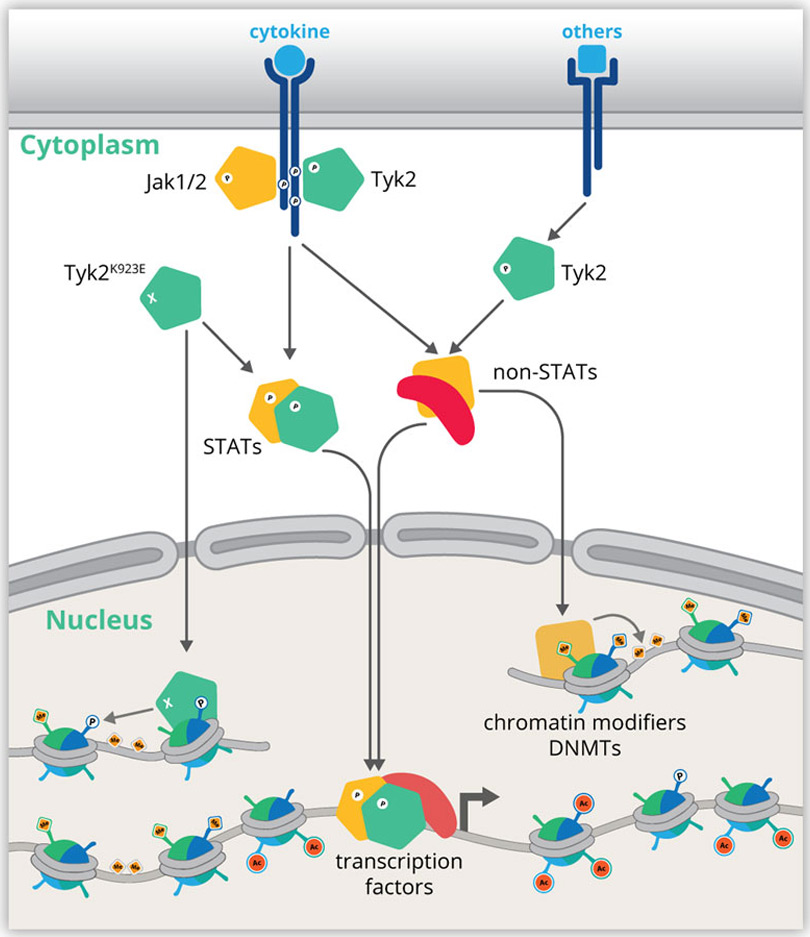
The focus of the proposed project part is to study Jak-Stat signaling in leukemogenesis and Natural Killer (NK) cell-mediated tumor surveillance. First, we will study mechanisms driving spontaneous leukemogenesis in Stat1
-/- animals to understand the tumor suppressing activity of Stat1 in myeloid leukemia. Interestingly, the phenotype of the disease changes upon transplantation and switches from a myeloid leukemia to a blast crisis-like disease displaying B cell-specific surface markers. We will investigate whether this change reflects a certain plasticity of the leukemic cells or whether different leukemic sub-clones drive the disease. Finally, we will identify signaling pathways accounting for leukemogenesis and disease maintenance in the absence of Stat1. Preliminary studies revealed that neither Stat3 nor Stat5 is activated; potential candidate signaling pathways include the NFκB, the hedgehog and the β-catenin pathways.
Recent work, including our own, has taught us that studies on signaling cascades have to consider cell-intrinsic and -extrinsic effects, i.e. the function of a particular signaling pathway in the leukemic cell and in the interaction with the tumor-environment, including immune cells. In leukemia, NK cells represent the main immune cell compartment responsible for tumor clearance. Hence, our second objective relates to Stat1 signaling in NK cell-dependent tumor surveillance. Whereas Stat1
-/- NK cells are immature and incapable of efficiently lysing leukemic cells, we did observe a partial rescue in NK cells derived from Stat1
Y701F mice that harbor a point mutation in the critical Jak-dependent tyrosine phosphorylation site. This suggests a critical non-canonical function of Stat1 in NK cells. Further support for a central function of Stat1 in NK cell biology stems from our observation that Cdk8-dependent phosphorylation of Stat1
S727 inhibits cytotoxicity. Accordingly, NK cells derived from Stat1
S727A mice are hyperactive and efficiently protect Stat1
S727A mice from tumors under NK cell-surveillance. Notably we observe Stat1 in NK cells at in the immunological synapse upon interaction with tumor target cells.
In the proposed subproject we aim to define both the leukemia-initiating cell and the cancer maintaining or cancer stem cell responsible for disease maintenance and the relevant signaling pathways in the absence of Stat1. Furthermore, we plan to unravel the function(s) of Stat1 within the immunological synapse and to study the impact of Stat1 on NK cell development and maturation.
Goals and Key Hypotheses:
Our aims are to identify the activities of Stat1 that suppress myeloid leukemia and account for NK cell-mediated tumor surveillance.
Working hypotheses for project 1:
Based on the finding that loss of Stat1 is sufficient to induce myeloid leukemia – thereby defining Stat1 as tumor suppressor – we have observed that leukemogenesis occurs in distinct steps and that Stat1
-/- leukemic cells show a consistent activation pattern of signaling pathways that maintain the leukemic state. This leads us to propose the following two working hypotheses:
(1) Loss of Stat1 in myeloid precursors - representing the cancer cells of origin (COC) - initiates the disease that requires an additional hit to manifest. Thereafter, disease maintenance is accomplished by a Lin+ leukemic stem cell (LSC).
(2) Stat1 loss triggers and/or complements alterations in other pathways, including NFγB, β-catenin and hedgehog signaling.
Working hypotheses for project 2:
While investigating the role of Stat1 in NK cells we observed that NK cell maturation depends on Stat1, while NK cells derived from Stat1
S727A mutant mice display higher cytotoxicity. This leads us to propose the following three working hypotheses:
(1) Stat1-dependent NK-cell maturation requires cell-extrinsic canonical Stat1-dependent MHC class I expression in the bone marrow.
(2) For full-fledged NK cell cytotoxicity, non-canonical cell-intrinsic functions of Stat1 are required in the immunological synapse.
(3) A tyrosine phosphorylation-independent function of Stat1 (U-Stat1) in the immunological synapse is required for NK-cell cytotoxicity.
Our specific goals are as follows:
Project 1:
(1) determine the COC as the origin of the disease; we will exploit Stat1
fl/fl mice to delete Stat1 in all hematopoietic cells (vav-Cre), in myeloid progenitors (ltf-Cre) and in B lymphoid (Mb1-Cre) cells.
(2) conduct RNA-Seq studies to determine disease-relevant signaling pathways triggered by loss of Stat1.
Project 2:
(1) analyse maturation of NK cells lacking Stat1 in NK cells only (Stat1
fl/fl Ncr1-Cre) and in NK cells only as well as in the entire hematopoietic compartment (Stat1
fl/fl vav-Cre).
(2) compare transcription by performing ChIP-Seq in wild-type, Stat1
S727A, and Stat1
Y701F NK cells.
(3) identify the interaction partners of Stat1 in NK cells using wild-type-, Stat1
Y701F- and Stat1
S727A-derived NK cells by immunoprecipitation of FLAG-tagged Stat1 followed by mass spectrometry.
Report on funding period 1 (03/2006-03/2010)
SFB-P10VS: Jak-Stat Involvement in Leukemogenesis and Lymphoma Development (Veronika Sexl)
JakStat signaling has been implicated in multiple aspects of cancer formation and tumor surveillance. A tumor suppressing role has been associated with Stat1 whereas Stat3 and Stat5 are considered to represent proto-oncogenes. Our work focuses on the role of Jak-Stat signaling for leukemia and lymphoma development. Despite the clear and unequivocal evidence for Stat1 as a tumor suppressor we demonstrated that Stat1 may also promote leukemia progression by interfering with the tumor-surveillance of leukemic cells by natural killer cells (NK cells). Stat1 represents a bottleneck for the expression of MHC I molecules, which represent key inhibitory signals for NK cells. Only in the presence of Stat1 and therefore MHC I the leukemic cells escape NK cell-mediated tumor surveillance and the leukemia may progress. We also observed that leukemic cells undergo a selection while forming disease in an immuno-competent organism and up-regulate MHC class I expression during this process. The general applicability of the concept was verified using a mouse model with Tel-Jak2-induced leukemia. Beside this, we found that Stat1 is a key regulator of NK cell functions. To further study Jak-Stat signaling in the NK cell compartment we have generated a transgenic mouse expressing Cre recombinase under the control of an NK cell specific promoter. Three founder lines are now available and we verified the tight expression within the NK cell compartment. In our second project we have studied the role of Jak2/Stat5 signaling for bcr/abl-induced leukemia. Using inducible conditional mouse model for Stat5 and Jak2 we show that Stat5 is absolutely essential for both, leukemia initiation as well as leukemia maintenance. Deletion of Stat5 in leukemic cells induces a cell cycle arrest followed by apoptosis in vitro as well as in vivo. This is true for both, bcr/abl-induced myeloid as well as lymphoid leukemia. The absolute necessity for Stat5 is also not relieved even when p53 signaling is disrupted. Furthermore we extended our investigations to the leukemic stem cell compartment. Lowering or removing Stat5 in the leukemic stem cells using MxCre-induced recombination ablated leukemia formation. In contrast, Jak2 was required for the initial transformation of lymphoid, but not myeloid cells by bcr/abl. Once the leukemia had established, Jak2 was no longer required to maintain bcr/abl-induced disease. This finding supports the concept that Stat5, but not Jak2 is a potential useful therapeutic target for the treatment of bcr/abl-induced lymphoid and myeloid leukemia.
Report on funding period 2 (03/2010-03/2013)
Report of Project Part 10: Jak-Stat Involvement in Leukemogenesis and NK-mediated tumor surveillance (Veronika Sexl)
The main focus of the laboratory was to understand Jak-Stat signaling in leukemogenesis and NK cell-dependent tumor surveillance using Bcr/Abl-driven leukemogenesis in transgenic mice as model system. In the last project period we investigated the role of Stat3 and Stat5 as well as the contribution of Jak2 for Bcr/Abl-induced disease initiation and maintenance. We found that both, Stat3 and Stat5 are required for the initial transformation of hematopoietic cells by Bcr/Abl oncogenes. Interestingly, Jak2 is only involved when lymphoid cells are transformed. Upon establishing the disease Jak-Stat signaling becomes rewired, Stat5 becomes a central signaling node. The deletion of Stat5, but not Jak2 or Stat3, in Bcr/Abl+ disease in vivo eliminates the leukemic cells. These findings establish Stat5 as potential therapeutic target for Bcr/Abl+ leukemia, particularly as the leukemic stem cell compartment also critically depends on the presence of Stat5. We could further delineate that Stat5 represents one factor that accounts for resistance against Bcr/Abl tyrosine kinase inhibitor therapy such as imatinib. Regarding Bcr/Abl+ leukemic stem cells we identified long- term hematopoietic stem cells (LT-HSCs) themselves as origin of CML and ALL. In the case of CML the LT-HSC also maintains the disease. In contrast, Bcr/Abl+ ALL is maintained by a CD19+ cell that is derived of the LT-HSC in the presence of interleukin-7 (IL-7).
Stat1 is regarded as counter player of Stat3 and Stat5 in tumor formation; whereas Stat3 and Stat5 promote tumor formation, Stat1 is considered a tumor suppressor. In line with this Stat1-/- mice spontaneously develop myelo-proliferative disorders and leukemia, which we are currently investigating in detail. During the course of this work we found that Stat1-/- mice develop mammary tumors that are attributed to both, Stat1 loss within the mammary epithelium as well as impaired tumor surveillance in Stat1-/- animals.
In the case of leukemia tumor surveillance is mainly achieved by NK cells. For studies on Jak-Stat signaling for NK cell-dependent leukemogenesis in vivo we generated Ncr1-Cre mice. This novel mouse strain expresses the Cre recombinase exclusively in NK cells and allowed us to delineate the absolute requirement for Stat5 within the NK cell compartment. Mice lacking Stat5 in NK cells lack mature NK cells and are incapable to fight NK cell-surveilled tumors.
We are currently elucidating an unexpected finding regarding Stat1 for NK cell biology. We found that Cdk8-dependent phosphorylation of a critical serine site in the transactivation domain of Stat1 (S727) inhibits NK cell activity. Accordingly, mice harboring a point mutation in this serine site (Stat1-S727A) are largely protected to develop NK cell-surveilled tumors.
CONTACT
Institute of Pharmacology and Toxicology
University of Veterinary Medicine Vienna, VMW
A-1210 Vienna, Austria
phone: +43(0)1 25077-2910; +43(0)1 664 60257-6291
veronika.sexl@vetmeduni.ac.at