AWARDS TO YOUNG SCIENTISTS (MARCH 2013)
Three young investigators of the goup of Veronika were awarded the prizes ‘Funds of the City of Vienna for Innovative Interdisciplinary Cancer Research’ for their first authorship publications:
Angelika Berger

SCHUSTER C., BERGER A., HOELZL M.A., PUTZ E.M., FRENZEL A., SIMMA O., MORITZ N., HOELBL A., KOVACIC B., FREISSMUTH M., MÜLLER M., VILLUNGER A., MÜLLAUER L., SCHMATZ A.I., STREUBEL B., PORPACZY E., JÄGER U., STOIBER D. UND SEXL V. (2011): The cooperating mutation or ‘second hit’ determines the immunologic visibility toward MYC-induced murine lymphomas. Blood 118(17):4635-45
Karoline Kollmann

KOLLMANN K., HELLER G., OTT R.G., SCHEICHER R., ZEBEDIN-BRANDL E., SCHNECKENLEITHNER C., SIMMA O., WARSCH W., ECKELHART E., HOELBL A., BILBAN M., ZÖCHBAUER-MÜLLER S., MALUMBRES M., SEXL V. (2011): c-JUN promotes BCR-ABL–induced lymphoid leukemia by inhibiting methylation of the 5′ region of Cdk6. Blood 117(15):4065-4075
Wolfgang Warsch

WARSCH W., KOLLMANN K., ECKELHART E., FAJMANN S., CERNY-REITERER S., HÖLBL A., GLEIXNER K.V., DWORZAK M., MAYERHOFER M., HOERMANN G., HERRMANN H., SILLABER C., EGGER G.,VALENT P., MORIGGL R., SEXL V. (2011): High STAT5 levels mediate imatinib resistance and indicate disease progression in chronic myeloid leukemia. Blood 117(12):3409-3420
Now available: Registration for the 2nd FEBS Special Meeting on JAK-STAT Signalling: Model Organisms and Beyond, Nottingham, UK, 12-15 September 2013
http://nott.ac.uk/jakstat2013; Maureen Mee
jak.stat@nottingham.ac.uk
FWF Board Decision (December 2012)
SFB F28 ,Jak-Stat Signalling: From Basics to Disease’ Funded until 2016
Based on the highly positive evaluation of the work performed in the previous three years and that proposed for the forthcoming funding period, the Board of the Austrian Science Fund (FWF) decided in its final meeting of 2012 to continue funding the Viennese Jak-Stat research consortium. In the third funding period the SFB will focus on canonical and non-canonical functions of Jak-Stat in immunity to infection and in haematopoietic malignancies. Two new group leaders have been incorporated in the consortium: Birgit Strobl, working on immunity to infection and tumour surveillance; and Robert Kralovics, who is focusing on myeloproliferative diseases. The work on gastrointestinal cancers carried out by the groups of Robert Eferl and Wolfgang Mikulits will be pursued in projects associated with the SFB.
paper release (octrober 2012)
OF MICE AND MAN
(Clinical Institute of Pathology, Medical University of Vienna, Vienna, Austria; Institute of Medical Genetics, Medical University of Vienna, Vienna, Austria; Institute of Pharmacology and Toxicology, Veterinary University Vienna, Vienna, Austria; Institute of Pathology, Medical University of Graz, Graz, Austria; Ludwig Boltzmann Institute for Cancer Research, Vienna, Austria; Laboratory for Immunological and Molecular Cancer Research, 3rd Medical Department of the Paracelsus Medical University, Salzburg, Austria; Department of Internal Medicine I, Division of Oncology, Medical University of Vienna, Vienna, Austria; Division of Hematology, Medical University of Graz, Graz, Austria; Harvard Stem Cell Institute, Harvard Medical School, Boston, Massachusetts, USA; Department of Medical Biochemistry, Max F. Perutz Laboratories, Medical University of Vienna, Vienna Biocenter, Vienna, Austria; Division of Molecular Histopathology, Department of Pathology, University of Cambridge, Addenbrooke's Hospital, Cambridge, UK; Pathology and Hematopathology Unit, Department of Hematology and Oncology 'L. and A. Seràgnoli,' S. Orsola-Malpighi Hospital, University of Bologna, Bologna, Italy; Department of Internal Medicine I, Division of Hematology and Hemostaseology, Comprehensive Cancer Center Drug & Target Screening Unit, Medical University of Vienna, Vienna, Austria; Ludwig Boltzmann Cluster Oncology, Vienna, Austria; Department of Molecular Biotechnology and Health Science, Center for Experimental Research and Medical Studies, University of Turin, Turin, Italy; Center for Molecular Medicine of the Austrian Academy of Sciences, Vienna, Austria; Department of Medicine I, Division of Infectious Diseases and Tropical Medicine, Medical University of Vienna, Vienna, Austria; Department of Pathology and NYU Cancer Center, New York University School of Medicine, New York, New York, USA; Department of Oncological Sciences, University of Turin, Turin, Italy; Laboratory of Oncogenomics, Institute for Cancer Research and Treatment, Candiolo, Italy; Worldwide Discovery Research, Cephalon, Inc., West Chester, Pennsylvania, USA; Department of Internal Medicine I, Institute for Cancer Research, Comprehensive Cancer Center, Medical University of Vienna, Vienna, Austria; Institute of Molecular Biotechnology of the Austrian Academy of Science, Vienna, Austria) concerning our paper:
PDGFR blockade is a rational and effective therapy for NPM-ALK–driven lymphomas. Daniela Laimer*, Helmut Dolznig*, Karoline Kollmann*, Paul W Vesely*, Michaela Schlederer, Olaf Merkel, Ana-Iris Schiefer, Melanie R Hassler, Susi Heider, Lena Amenitsch, Christiane Thallinger, Philipp B Staber, Ingrid Simonitsch-Klupp, Matthias Artaker, Sabine Lagger, Suzanne D Turner, Stefano Pileri, Pier Paolo Piccaluga, Peter Valent, Katia Messana, Indira Landra, Thomas Weichhart, Sylvia Knapp, Medhat Shehata, Maria Todaro, Veronika Sexl, Gerald Höfler, Roberto Piva, Enzo Medico, Bruce A Ruggeri, Mangeng Cheng, Robert Eferl, Gerda Egger, Josef M Penninger, Ulrich Jaeger, Richard Moriggl, Giorgio Inghirami & Lukas Kenner
is published online in the journal Nature Medicine 2012. doi: 10.1038/nm.2966.
* equal contribution
Of mice and men
The use of carefully chosen animal models often underlies crucial medical advances. A perfect example is provided by the recent demonstration that a known drug, imatinib, can be used to treat a rare but highly aggressive type of lymphoma. The work was largely undertaken in the group of Lukas Kenner at the Ludwig Boltzmann Institute for Cancer Research and the Medical University of Vienna with the support of Karoline Kollmann and Veronika Sexl at the University of Veterinary Medicine, Vienna, together with a number of national and international collaborators. The findings are published in the current issue of the prestigious journal Nature Medicine.
So-called Anaplastic Large Cell Lymphoma (ALCL) is even less attractive in real life than it is on paper. It is a highly aggressive type of lymphoma that generally occurs in children and young adults and that has to date proven extremely difficult to treat. It has long been known that ALCL patients frequently show a genetic alteration (a translocation) that causes expression of nucleophosmin-anaplastic lymphoma kinase (NPM-ALK), a gene known to be capable of giving rise to cancer. But how the NPM-ALK gene works has to date remained largely a matter of conjecture.
Working in a mouse model for lymphoma, Karoline Kollmann in Veronika Sexl’s group at the University of Veterinary Medicine, Vienna and colleagues in the Ludwig Boltzmann Institute for Cancer Research and the Medical University of Vienna were able to show that the development of lymphoma is absolutely dependent on the “Platelet derived growth factor receptor B” (PDGFRB), a protein already associated with the growth of other types of tumour. They demonstrated that the effect was direct, with NPM-ALK stimulating the production of the transcription factors JUN and JUNB, which bind to and activate the PDGFRB promoter. And importantly they were able to show that inhibition of PDGFRB with the (known) drug imatinib was able to extend dramatically the survival of mice with this kind of lymphoma.
In human patients, ALCL is traditionally treated with crizotinib, a drug that directly inhibits the NPM-ALK protein. The major problem is that the patients tend to relapse and their chances of survival are extremely poor. Based on the results from the imatinib tests in mice it seemed conceivable that the use of this drug might improve the prognosis of patients who do not or no longer respond to crizotinib therapy. The scientists obtained ethical approval and informed consent to attempt imatinib treatment of an ALCL patient who had not responded to conventional chemotherapy and had relapsed after transplantation of stem cells. Remarkably, the patient improved immediately upon imatinib treatment: after ten days he was in complete remission and he is still alive – and again working – 19 months later.
The idea of inhibiting PDGFRB in ALCL is novel and potentially of great therapeutic importance. Kollmann is naturally extremely excited by the implications of the results. “The patient had essentially run out of options and would have died a long time ago. But thanks to the indications from our mouse work that inhibiting PDGFRB could prevent growth of this type of tumour he is still alive. This new type of therapy could significantly prolong patient survival.”
Intriguingly, the researchers have also found that PDGRFB is also present in ALCL patients without the translocation that leads to NPM-ALK expression. Whether the PDGRFB protein is required for the development of tumours in such patients is not yet clear but it is possible that a combined crizotinib / imatinib therapy might be more widely applicable, providing hope for patients suffering from other types of lymphoma.
The paper Identification of PDGFR blockade as a rational and highly effective therapy for NPM-ALK driven lymphomas by Daniela Laimer, Helmut Dolznig, Karoline Kollmann, Paul W. Vesely, Michaela Schlederer, Olaf Merkel, Ana-Iris Schiefer, Melanie R. Hassler, Susi Heider, Lena Amenitsch, Christiane Thallinger, Philipp B. Staber, Ingrid Simonitsch-Klupp, Matthias Artaker, Sabine Lagger, Stefano Pileri, Pier Paolo Piccaluga, Peter Valent, Katia Messana, Indira Landra, Thomas Weichhart, Sylvia Knapp, Medhat Shehata, Maria Todaro, Veronika Sexl, Gerald Höfler, Roberto Piva, Enzo Medico, Bruce A. Riggeri, Mangeng Cheng, Robert Eferl, Gerda Egger, Josef M. Penninger, Ulrich Jaeger, Richard Moriggl, Giorgio Inghirami and Lukas Kenner is published in the current issue of Nature Medicine. The first four authors contributed equally to the work.
About the University of Veterinary Medicine, Vienna
The University of Veterinary Medicine, Vienna is the only academic and research institution in Austria that focuses on the veterinary sciences. About 1000 employees and 2300 students work on the campus in the north of Vienna, which also houses the animal hospital and various spin-off-companies.
http://www.vetmeduni.ac.at
Written by:
Graham Tebb
Advancement of Research and Innovation
University of Veterinary Medicine, Vienna
T + 43 1 25077 1021
graham.tebb@vetmeduni.ac.at
Contact:
Klaus Wassermann
T +43 1 25077-1153
klaus.wassermann@vetmeduni.ac.at
Scientific contact:
Prof. Veronika Sexl
T +43 1 25077-2910
veronika.sexl@vetmeduni.ac.at
paper release (july 2012)
TAKING A HIT OR TWO
(Ludwig Boltzmann Institute for Cancer Research, Vienna Austria; Spanish National Cancer Research Centre (CNIO), Madrid Spain; Institute of Molecular Biotechnology (IMBA), Vienna Austria; Institute of Animal Breeding and Genetics, Vetmeduni Vienna Austria; Institute of Laboratory Animal Science and Biomodels Austria, Vetmeduni Vienna Austria; Department Agrobiotechnology, Institute of Biotechnology in Animal Production, University of Natural Resources and Applied Life Sciences, Tulln Austria; Clinical Institute of Pathology, Medical University of Vienna (MUW) Austria; Institute of Pharmacology, MUW Vienna Austria; Institute of Pathology, Medical University of Graz, Austria; Institute of Cancer Research, MUW Vienna Austria) concerning our paper:
A mouse model to identify cooperating signaling pathways in cancer Monica Musteanu*, Leander Blaas*, Rainer Zenz, Jasim Svinka, Thomas Hoffmann, Beatrice Grabner, Daniel Schramek, Hans-Peter Kantner, Mathias Müller, Thomas Kolbe, Thomas Rülicke, Richard Moriggl, Lukas Kenner, Dagmar Stoiber, Josef Penninger, Helmut Popper, Emilio Casanova and Robert Eferl
is published online in the journal Nature Methods 2012, DOI: 10.1038/nmeth.2130
* equal contribution
TAKING A HIT OR TWO
Despite a huge amount of research effort, the molecular mechanisms that underlie the transition from a “normal” cell to a cancerous cell are only poorly understood. After the discovery of the first cancer-causing genes or oncogenes and the finding that they are mutated forms of normal cellular genes, it was widely believed that a single mutation was enough to cause cancer. Subsequent research, however, has revealed that most cancers only develop as a result of several mutations. A bewildering variety of combinations of mutations have been shown to have the potential to give rise to cancer. Finding out which combinations are dangerous has to date been largely a matter of trial and error but this should change with the development of a tool to identify mutations that really do collaborate to cause cancer. Robert Eferl and colleagues announce the new “Multi-Hit” mouse in the current issue of the journal “Nature Methods”. The work is one result of a longstanding collaboration between many institutions in the Vienna area coordinated by Mathias Müller of the University of Veterinary Medicine, Vienna.
It is now generally accepted that cancer only arises if two or more genes are mutated. To date, learning which combinations of mutations cause cancer has represented an extremely laborious endeavour but the development of the “Multi-Hit” mouse looks set to change this. The group of Robert Eferl at the Ludwig Boltzmann Institute for Cancer Research, Vienna has taken advantage of the Cre-recombinase system to generate random combinations of correctly and incorrectly oriented oncogenes (or tumour suppressor genes, genes whose inactivation may contribute to the development of cancer) and investigated which of the combinations caused tumours.
They tested their system on the well-known Ras protein, which has been shown to be mutated in many different cancers. Ras mutations were thought to cause cancer only if the so-called Raf gene was also mutated but it has more recently been proposed that changes in other genes, such as those encoding the RALGEF (Ral guanine nucleotide exchange factor), MAPK (mitogen-activated protein kinase) or PI3K (phosphatitylinositol-3-kinase) proteins, may also combine with mutated Ras proteins to cause tumour development. The researchers found that mutations in Ras alone did not cause tumours to develop, while following activation of the Cre recombinase (and thus random activation – by flipping – of the genes under study) all mice developed cancer.
Examination of the tumours showed that in most of them all three genes had been activated, although activation of the P13K gene alone (and in very rare cases of one of the other two genes alone) could also give rise to cancer. In other words, the most rapidly proliferating, and thus most life-threatening, tumours were associated with activation of all three of the genes investigated. This indicates that all the genes are somehow contributing to the development of cancer, which means that drugs targeting any or all of them could play a part in treatment.
Eferl, now at the Institute for Cancer Research & Comprehensive Cancer Center of the Medical University of Vienna, is naturally excited by the results. “Our work on Ras has given important clues to possible therapeutic strategies. But this was really only a proof-of principle. More importantly, the results show that our Multi-Hit mouse can indeed be used to study interactions between gene mutations. This should make it much easier for us to understand how cancer arises and what we can do to treat it.”
The paper “A mouse model to identify cooperating signalling pathways in cancer” by Monica Musteanu, Leander Blaas, Rainer Zenz, Jasmin Svinka, Thomas Hoffmann, Beatrice Grabner, Daniel Schramek, Hans-Peter Kantner, Mathias Müller, Thomas Kolbe, Thomas Rülicke, Richard Moriggl, Lukas Kenner, Dagmar Stoiber, Josef Penninger, Helmut Popper, Emilio Casanova and Robert Eferl is published in the current issue of “Nature Methods” (DOI: 10.1038/nmeth.2130).
The work was partially funded by a grant from the Austrian Science Fund to Robert Eferl and Mathias Müller as part of the Priority Research Programme “JakStat” coordinated by Mathias Müller at the Vetmeduni Vienna.
Abstract of the scientific article online (full text for a fee or with a subscription): http://dx.doi.org/10.1038/nmeth.2130
Scientific contacts
Prof. Robert Eferl
Institut for Cancer Research and Comprehensive Cancer Center Vienna
Medical University of Vienna
T +43 1 40160-71240
robert.eferl@meduniwien.ac.at
Prof. Mathias Müller
Institut für Tierzucht und Genetik
University of Veterinary Medicine, Vienna
T +43 1 25077-5620
mathias.mueller@vetmeduni.ac.at
Written by:
Graham Tebb
Advancement of Research and Innovation
University of Veterinary Medicine, Vienna
T + 43 1 25077 1021
graham.tebb@vetmeduni.ac.at
Distributed by:
Klaus Wassermann
Public Relations/Science Communication
University of Veterinary Medicine, Vienna
T +43 1 25077-1153
klaus.wassermann@vetmeduni.ac.at
paper release (june 2012)
A MOUSE MODEL TO DISSECT TYK2 KINASE-DEPENDENT AND –INDEPENDENT FUNCTIONS
(Institute of Animal Breeding and Genetics, University of Veterinary Medicine Vienna, Austria; Biomodels Austria, University of Veterinary Medicine Vienna; Genetic Reprogramming Group Agricultural Biotechnology Center, Gödöllö Hungary; Department for Agrobiotechnology IFA Tulln, University of Natural Resources and Life Sciences Vienna; Institute of Laboratory Animal Science, University of Veterinary Medicine Vienna, Austria; Molecular Animal Biotechnology Laboratory Szent Istvan University and BioTalentum Ltd., Gödöllö Hungary) concerning our paper:
TYK2 Kinase Activity Is Required for Functional Type I Interferon Responses In Vivo Michaela Prchal-Murphy, Christian Semper, Caroline Lassnig, Barbara Wallner, Christian Gausterer, Ingeborg Teppner-Klymiuk, Julianna Kobolak, Simone Müller, Thomas Kolbe, Marina Karaghiosoff, Andras Dinnyés, Thomas Rülicke, Nicole R. Leitner, Birgit Strobl and Mathias Müller is published online in the journal PLoS ONE (7(6): e39141. doi:10.1371/journal.pone.0039141)
A MOUSE MODEL TO DISSECT TYK2 KINASE-DEPENDENT AND –INDEPENDENT FUNCTIONS
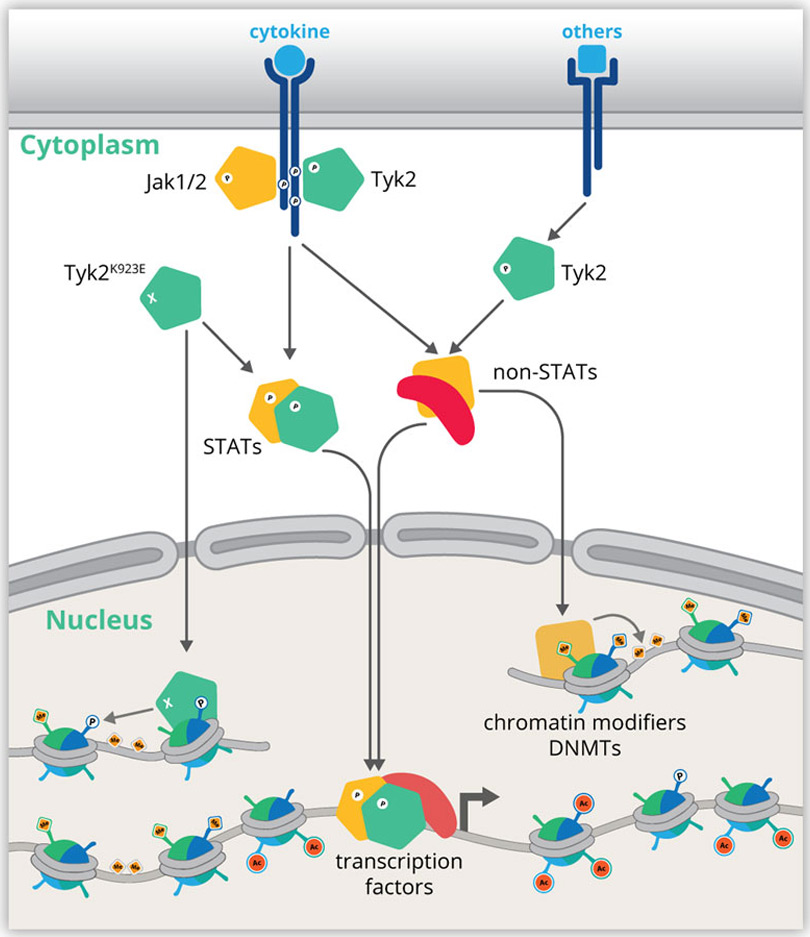
The work describes the initial characterisation of a genetically engineered mouse model expressing the kinase-inactive form of Tyk2, a member of the Janus kinase (Jak) family of tyrosine kinases. In addition to interferons analysed in this study, Tyk2 is engaged by several other cytokines. Dysregulated Tyk2 activity has been linked in human genetic association studies with autoimmune or autoinflammatory disorders and in mouse models with altered tumor surveillance and host-pathogen interaction. Jak3 and Jak2 inhibitors are already in various clinical trial, Tyk2 inhibitors are in the pipeline of several pharmaceutical companies.
Tyk2K923E mice are a highly valuable tool to dissect kinase-dependent (canonical) and kinase-independent (non-canonical) functions of Tyk2 in vivo and to study the side effects of the Jak inhibitors available, or under development, with respects to their side effects and efficacy in vivo.
We therefore believe that our novel mouse model will be instrumental for the basic research community focussing on Jak-Stat signalling as well as for translational or clinical researchers exploiting the potential of Jak inhibitors in clinical settings.
About the Vienna University of Veterinary Medicine
The University of Veterinary Medicine, Vienna is the only academic and research institution in Austria that focusses on the veterinary sciences. About 1000 employees and 2300 students work on the campus in the north of Vienna, which also houses the animal hospital and various spin-off-companies.
www.vetmeduni.ac.at
About Biomodels Austria
The University of Veterinary Medicine, Vienna operates Biomodels Austria as academic non-profit research and enabling platform for (i) the generation of genetically engineered biomodels (rodents), (ii) the breeding, sanitation and archiving of biomodels, (iii) the genetic and post-genome characterisation of biomodels, and (iv) the in vivo challenges of biomodels on biosafety level 2/3 according to the international guidelines. Biomodels Austria closely collaborates with the Medical University of Vienna, and other life science institutions including MFPL, CeMM and LBI-CR. Biomodels Austria is a full member of the European Mouse Mutant Archive (EMMA, www.emmanet.org) and the European Infrastructure for Phenotyping and Archiving of Model Mammalian Genomes (Infrafrontier, www.infrafrontier.eu) .
www.biomodels.at
Comment written by:
Mathias Müller
Vetmeduni Vienna
mathias.mueller@vetmeduni.ac.at
paper release (june 2012)
CELL TYPE SPECIFIC REQUIREMENTS OF STAT1 FOR THE DEFENCE AGAINST LISTERIA MONOCYTOGENES
(Max F. Perutz Laboratories, University of Vienna; Ludwig Boltzmann Institute for Cancer Research, Vienna; Institute of Pharmacology, Centre for Physiology and Pharmacology, Medical University of Vienna; Institute of Animal Breeding and Genetics, University of Veterinary Medicine Vienna; Institute of Pharmacology and Toxicology, University of Veterinary Medicine Vienna; Biomodels Austria, University of Veterinary Medicine Vienna; Department of Microbiology and Immunology, Columbia University Medical Center, New York, United States of America; Twincore, Center for Experimental and Clinical Infection Research, Hannover, Germany) concerning our paper:
Conditional Stat1 Ablation Reveals the Importance of Interferon Signaling for Immunity to Listeria monocytogenes Infection. Kernbauer, Verena Maier, Dagmar Stoiber, Birgit Strobl, Christine Schneckenleithner, Veronika Sexl, Ursula Reichart, Boris Reizis, Ulrich Kalinke, Amanda Jamieson, Mathias Müller and Thomas Decker is published online in the journal PLoS Pathogens (8(6): e1002763. doi:10.1371/journal.ppat.1002763)
CELL TYPE SPECIFIC REQUIREMENTS OF STAT1 FOR THE DEFENCE AGAINST LISTERIA MONOCYTOGENES
Due to the central role of Stat1 for responses to interferons, Stat1-deficient mice are hypersensitive to infection with all pathogens. For this reason it has not been possible in most situations to study the immune response beyond the very early stages of infection. We have overcome this limitation by generating (Wallner et al, 2012 Transgenic Research 21, 1: 217) and analysing mice with Stat1 gene ablation in macrophages, T cells and dendritic cells. Two striking features of Stat1 signaling during Listeria monocytogenes (Lm) infection emerge from our work, the antagonistic effects of Stat1 ablation in macrophages and T cells for innate protection against Lm and the change particularly in T cells from immunesuppressive to protective signalling in innate and secondary, memory-base immune responses, respectively.
About the Max F. Perutz Laboratories
The Max F. Perutz Laboratories were established in 2005 at the Campus Vienna Biocenter as a joint venture between the University of Vienna and the Medical University of Vienna. The MFPL house more than sixty groups performing research on topics relating to molecular biology. From 2007 the Laboratories have been headed by biochemist Graham Warren.
www.mfpl.ac.at
About the Vienna University of Veterinary Medicine
The University of Veterinary Medicine, Vienna is the only academic and research institution in Austria that focusses on the veterinary sciences. About 1000 employees and 2300 students work on the campus in the north of Vienna, which also houses the animal hospital and various spin-off-companies.
www.vetmeduni.ac.at
Comment written by:
Thomas Decker
MFPL
thomas.decker@univie.ac.at
EUROPEAN HEMATOLOGY ASSOCIATION FELLOWSHIPS & GRANTS COMMITTEE MEMBERSHIP (JUNE 2012)
Veronika Sexl has accepted the honourable invitation to join the Fellowships and Grants Committee of the European Hematology Association (EHA)
The EHA Fellowships and Grants Committee (www.ehaweb.org) peer reviews and selects the winners of the EHA Fellowships Program and advises the EHA Board on issues regarding this program, initiating improvements to the program and promoting the value of it. Veronika Sexl agreed to be a committee member for a term of three years.
Online Available: ‘Jak-Stat Signaling: From Basics to Disease’, Thomas Decker & Mathias Müller (Eds.)
‘Jak-Stat Signaling: From Basics to Disease’ - A comprehensive book about Jaks, Stats and signal transduction
The first comprehensive book about Jak-Stat signalling in seven years will be released on June 30 2012 from Springer publishers (Springer.com). The book edited by the speaker and deputy speaker of the correspondent FWF SFB gives overview and insight into recent research findings on the evolution and regulation of Jaks and Stats, on the function of Jak-Stat signalling in soft and solid cancer, infection, inflammation and cell metabolism.
Award to young scientist (march 2012)
A young investigator of the group of Veronika Sexl was recently awarded the following prize:
Andrea Hölbl received the sponsorship award ‘Funds of the City of Vienna for Innovative Interdisciplinary Cancer Research’ (City Hall of Vienna, March 5th 2012)

Andrea Hölbl thanking the officials for the award.

Prof. Dr. Wolfgang Schütz, rector of the Medical University of Vienna, hands over the award document.
paper release (january 2012)
JAK OF ALL TRADES? NOT OF LEUKAEMIA THERAPY!
(University of Veterinary Medicine Vienna; CeMM Research Center Austrian Academy of Sciences, Vienna; Swiss Institute for Experimental Cancer Research, Lausanne, Switzerland; Medical University of Vienna; Eppley Institute for Research in Cancer and Allied Diseases, University of Nebraska Medical Center, Omaha, Nebraska, USA) concerning our paper:
BCR-ABL uncouples canonical JAK2-STAT5 signaling in chronic myeloid leukemia. Oliver Hantschel*, Wolfgang Warsch*, Eva Eckelhart*, Ines Kaupe, Florian Grebien, Kay-Uwe Wagner, Giulio Superti-Furga° and Veronika Sexl° is published online in the journal Nature Chemical Biology (2012, Vol. 8; doi: 10.1038/nchembio.775.).
* equal contribution
° corresponding authors
JAK OF ALL TRADES? NOT OF LEUKAEMIA THERAPY!
About one in five or six cases of adult leukaemia in Western populations relates to so-called chronic myeloid leukaemia, or CML. Treatment of CML usually relies on inhibitors of the abnormal protein that causes the condition but some patients do not respond to treatment and efforts are underway to develop a supplementary approach, targeting the so-called JAK2 kinase. Recent results from the groups of Veronika Sexl at the University of Veterinary Medicine, Vienna (Vetmeduni Vienna) and Giulio Superti-Furga at the Research Center for Molecular Medicine of the Austrian Academy of Sciences (CEMM) have called this strategy into question. The work is published in the current issue of the prestigious journal Nature Chemical Biology and is of immediate relevance to leukaemia treatment.
The cause of CML has been known since 1960, when two scientists in Philadelphia, Pennsylvania showed that the disease was associated with a particular genetic abnormality, the “Philadelphia chromosome”. Philadelphia chromosomes represent the result of an incorrect crossing-over between two chromosomes, through which part of the Bcr (“breakpoint cluster region”) gene from chromosome 22 fuses with the Abl gene on chromosome 9. The fusion gene product is a tyrosine kinase, i.e. it can phosphorylate other proteins on tyrosine residues. When it does so, it incorrectly activates several signal pathways controlling cell division in white blood cells and leads to leukaemia. Thankfully, drugs have been developed that prevent the kinase activity of the BCR-ABL fusion protein and the majority of patients treated with such tyrosine kinase inhibitors (e.g. imatinib) show no further signs of leukaemia.
Unfortunately, however, patients may develop resistance to the therapy so an alternative approach is required. Recent developments have focused on the use of drugs targeting another kinase involved in CML, the JAK2 kinase. In normal white blood cells, JAK2 is known to activate a further molecule, known as STAT5, which is absolutely required for the development of CML. The argument runs that if JAK2 could be specifically inhibited – and thus STAT5 not activated – it would bring fresh hope to patients who do not respond to treatment with imatinib. Several potential inhibitors of JAK2 are currently undergoing clinical trials and may shortly be available for treating patients.
The theory is appealing but to date we do not really understand exactly what happens when JAK2 is inactivated following the initiation of leukaemia by the Bcr-Abl oncogene. Sexl and her colleagues have used a transgenic mouse model to clarify the functions of these proteins in leukaemia. Their results were highly unexpected. The JAK2 kinase was found to be not required for the maintenance of the disease, i.e. inhibiting JAK2 in leukaemic cells had no therapeutic benefit. However, inhibition of STAT5 in leukaemia was sufficient to prevent cell proliferation. As Sexl says, “this means that the normal signalling pathway is completely rewired in CML cells: STAT5 activity no longer depends on JAK2.” In support of this conclusion, the researchers were able to show that the BCR-ABL protein directly phosphorylates STAT5, thereby activating it.
Superti-Furga: “The findings have extremely important consequences for CML therapy in humans and I am happy about the successful collaboration between my team at CeMM and the group of Veronika Sexl”. Put bluntly, leukaemia patients that do not respond to imatinib will not be helped by inhibiting JAK2. Interestingly, some JAK2 inhibitors do slow the progression of leukaemic cells, although they must be given at very high levels. The “therapeutic” action is mediated by a secondary target of the JAK2 inhibitors, which Sexl and colleagues have shown to be the Bcr-Abl oncogene itself. Sexl concludes that, “at the moment there is simply no rationale for giving leukaemic patients JAK2 inhibitors. If we want to help patients who do not respond to imatinib, we should concentrate instead on developing inhibitors to STAT5.”
The work was supported by grants WWTF-LS037 and SFB-28-10 to V.S. and GenAU-PLACEBO to G.S.-F. and V.S
About the Vienna University of Veterinary Medicine
The University of Veterinary Medicine, Vienna is the only academic and research institution in Austria that focuses on the veterinary sciences. About 1000 employees and 2300 students work on the campus in the north of Vienna, which also houses the animal hospital and various spin-off-companies.
www.vetmeduni.ac.at
About CeMM, the Research Center for Molecular Medicine of the Austrian Academy of Sciences
CeMM is an international, independent and interdisciplinary research Center in Molecular Medicine. “From the clinic to the clinic”: driven by medical needs, CeMM integrates basic research and clinical expertise to pursue innovative diagnostic and therapeutic approaches focused on cancer, inflammation and immune disorders.
www.cemm.oeaw.ac.at
Contact:
Klaus Wassermann, Klaus.Wassermann@vetmeduni.ac.at, Tel. +43-1-25077-1153
Eva Schweng: ESchweng@cemm.oeaw.ac.at; Tel. +43-1-40160-70051
Scientific contact:
Prof. Veronika Sexl, Veronika.Sexl@vetmeduni.ac.at, Tel.+43-1-25077-2910
Prof. Giulio Superti-Furga, GSuperti@cemm.oeaw.ac.at, Tel. +43-40160-70001
AWARDS TO YOUNG SCIENTISTS (OCTOBER 2011)
Young investigators of the groups of Veronika Sexl and Thomas Decker were recently awarded for their scientific work the following prizes:
- Matthias Farlik (Thomas Decker Group) recieved the Ursula & Fritz Melchers PhD Award at the Annual Meeting 2011 of the Austrian Society for Allergology and Immunology (ÖGAI, Sept. 15th to 17th 2011, Graz, Austria)
- Eva Maria Putz (Veronika Sexl group) was awarded a travel grant of the European Federation of Immunological Societies (EFIS) and the European Journal of Immunology (EJI) for the participation at the EMBO conference "Signaling in the immune system" (Sept. 10th to 14th 2011, Siena, Italy)
- Wolfgang Warsch (Veronika Sexl group) received the Wilhelm Türk Preis of the Austrian Society for Haematology and Oncology (OEGHO) for the Blood paper "High STAT5 level mediate imatinib resistance and indicate disease progression in chronic myeloid leukemia" (Blood 2011; 117:3408-3420). The prize was awared at the Annual Meeting 2011 of the German, Austrian and Swiss Societies for Haematology and Oncology (Spet. 30th to Oct. 4th 2010, Basel, Switzerland). Wolfgang also received a travel grant of the European School of Haematology (ESH) fort he participitation Teilnahme at the CML Congress ESH-iCMLf CML - Biology and Therapy (Sept. 22nd to 25th 2011, Estoril, Portugal). Finally Wolfgang was awarded the prize for the best Flash Talk "Targeting STAT5 in CML: Mechanism-of-action of JAK2 tyrosine kinase inhibitors in CML unmask a direct BCR-ABL/STAT5 axis" at the Annual Meeting 2011 of the Austrian Society for Molecular Biotechnology (OEGMBT) donated by the Austrian Federal Ministry for Science and Research (BM_WFa) (Sept. 28th to 30th 2011, Puch bei Salzburg, Austria)
Hartmut Beug 1945-2011
We sadly announce that Hartmut Beug passed away on 3 July 2011
In memoriam
paper release (june 2011)
REVIEWING THE FUNCTIONS OF TYK2, STAT3 And STAT5 IN HOST IMMUNITY AND CARCINOGENESIS
(Vetmeduni Vienna, Ludwig Boltzmann Institute for Cancer Research, Medical University of Vienna)
The June issue of the Landmark Edition of Frontiers in Biocience (
http://www.bioscience.org/current/currissu.htm) publishes three reviews on Jak-Stat functions in disease of members of the Vienna Jak-Stat consortium.
Serine phosphorylation of the Stat5a C-terminus is a driving force for transformation
Friedbichler, K., Hoelbl, A., Li, G., Bunting, K.D., Sexl, V., Gouilleux, F., and Moriggl, R. (2011) Front Biosci 17, 3043-3056.
Abstract. Persistent tyrosine phosphorylation of Stat3 and Stat5 is associated with oncogenic activity. Phosphorylation of the conserved tyrosine residue (pTyr) was long believed to be the only essential prerequisite to promote activation and nuclear translocation of Stat proteins. It has become evident, however, that post-translational protein modifications like serine phosphorylation, acetylation, glycosylation as well as protein splicing and processing constitute further regulatory mechanisms to modulate Stat transcriptional activity and to provide an additional layer of specificity to Jak-Stat signal transduction. Significantly, most vertebrate Stat proteins contain one conserved serine phosphorylation site within their transactivation domains. This phosphorylation motif is located within a P(M)SP sequence. Stat transcription factor activity is negatively influenced by mutation of the serine to alanine. Moreover, it was shown for both Stat3 and Stat5 that their capacity to transform cells was diminished. This review addresses recent advances in understanding the reg2011ulation and the biochemical and biological consequences of Stat serine phosphorylation. In particular, we discuss their role in persistently activated Stat proteins for cancer research.
JAK-STAT signaling in hepatic fibrosis
Mair, M., Blaas, L., Osterreicher, C.H., Casanova, E., and Eferl, R. (2011) Front Biosci 17, 2794-2811.
Abstract. Chronic liver injury, liver fibrosis and formation of hepatocellular carcinoma are intimately linked and represent a major medical challenge since treatment options are limited. Therefore, it is important to identify cellular and molecular pathways that promote liver damage or provide hepatoprotection for development of therapeutic approaches. Recently, the transcription factors STAT3 and STAT5 have been implicated in liver fibrosis induced by cholestatic liver damage. In this review, we summarize our current knowledge about STAT proteins in liver fibrosis and focus on common activities that underlie the hepatoprotective mechanisms regulated by IL-6/gp130/STAT3 and GH/STAT5/IGF-1 signaling pathways.
Tyrosine kinase 2 (Tyk2) in cytokine signalling and host immunity
Strobl, B., Stoiber, D., Sexl, V., and Müller, M. (2011) Front Biosci 17, 3224-3232.
Abstract. The Janus kinase (JAK)/signal transducer and activator of transcription (STAT) signal transduction pathway is essential to transmit signals from transmembrane receptors to the nucleus in order to alter gene expression programs and to respond to extracellular cues. Tyrosine kinase 2 (TYK2) was the first member of the JAK family that was identified within a screen for molecules complementing human cell lines mutant for interferon (IFN) responses. During the last decades biochemical studies and gene-targeted mice uncovered the crucial role of TYK2 in immunity. Tyk2-deficient mice are viable and fertile but display multiple immunological defects, most prominently high sensitivity to infections and defective tumour surveillance. In contrast, absence of TYK2 results in increased resistance against allergic, autoimmune and inflammatory diseases. In support of these data, the only patient with TYK2 deficiency described so far displays high serum immunoglobulin E (IgE) levels and increased sensitivity to infectious diseases. Furthermore, numerous genome-wide association studies in humans propose a link between TYK2 genetic variants and several autoimmune diseases, inflammatory diseases and tumours. Thus, TYK2 appears as an attractive target for therapeutic intervention. Future work will be required to further delineate structure-function relationships and to fully understand the involvement of TYK2 in immune regulatory networks.
paper release (february 2011)
Natural (born) killers: what do they really do?
(Vetmeduni Vienna, Medical University of Vienna, Ludwig Boltzmann Institute for Cancer Research) concerning our paper:
A novel Ncr1-Cre mouse reveals the essential role of STAT5 for NK cell survival and development. Eva Eckelhart, Wolfgang Warsch, Eva-Maria Zebedin, Olivia Simma, Dagmar Stoiber, Thomas Kolbe, Thomas Rülicke, Mathias Mueller, Emilio Casanova and Veronika Sexl. Blood, Vol.117, Issue 5, Feb. 2011
Natural (born) killers: what do they really do?
Our immune systems contain three fundamentally different types of cell: B-cells, T-cells and the mysteriously named Natural Killer cells (NK cells), which are known to be involved in killing tumour cells and other infected cells. Experiments to investigate the function of NK cells have proven difficult to interpret because the interactions between the various components of the immune system make it almost impossible to isolate effects of individual cell types. This has changed with the development of a mouse in which individual genes can be knocked out (eliminated) only in NK cells, thereby providing scientists with a tool to study the importance of NK cells and indeed of individual pathways in these cells. The mouse was generated in the group of Veronika Sexl, who has recently moved from the Medical University of Vienna to the University of Veterinary Medicine, Vienna. An initial characterization is presented in the current issue of the journal Blood.
The development of a tool alone would not normally generate headlines but this case is different: the new mouse can be used to knock out any gene completely and exclusively in NK cells. It thus permits researchers to examine the functions of NK cells in the entire organism or even to investigate the importance of individual genes in this particular cell-type.
Sexl herself has naturally used the tool already. She has been able to show that a particular transcription factor known as Stat5 is essential for the correct development of NK cells – when this factor is eliminated, the cells fail to develop properly. The upshot is a mouse with an immune system that lacks NK cells but is otherwise fully intact. This is the first time it has proven possible to remove this particular cell type without affecting the rest of the animal. Finally, then, it is possible to learn what NK cells actually do in the intact organism.
Sexl and her collaborators have shown that mice lacking NK cells have normal T-cell responses to tumours, although their NK cell-mediated responses are naturally dramatically reduced. This experiment proves conclusively that the mouse can be used to untangle the web of interactions among the various cells of the immune system.
Sexl’s work has immediate implications for the treatment of cancer in humans. As an example, leukemia is sometimes treated by inhibiting the STAT5 protein. Sexl’s findings make it clear that this approach has a real drawback: inhibition of STAT5 will lead to a drop in the number of NK cells and so interfere with one of the body’s own mechanisms for fighting the cancer. It will be important to assess whether NK cells normally play a part in fighting diseases before inhibiting STAT5. For the first time, the newly developed mouse provides a tool to do so. Not surprisingly, it is already attracting a great deal of interest – as Sexl says, “They’ve been going like hot cakes ever since the word got out.”
The paper A novel Ncr1-Cre mouse reveals the essential role of STAT5 for NK cell survival and development by Eva Eckelhart, Wolfgang Warsch, Eva Zebedin, Olivia Simma, Dagmar Stoiber, Thomas Kolbe, Thomas Rülicke, Mathias Mueller, Emilio Casanova and Veronika Sexl is published in the February 2011 issue of the journal Blood (2011, Vol. 117, pp. 1565-73). Although Sexl has only just joined the University of Veterinary Medicine, Vienna she has had a long association with the University and her recent work was performed in close collaboration with a number of its scientists as well as with the group of Emilio Casanova at the Ludwig Boltzmann Institute for Cancer Research, Vienna.
About the Vienna University of Veterinary Medicine
The University of Veterinary Medicine, Vienna is the only academic and research institution in Austria that focusses on the veterinary sciences. About 1000 employees and 2300 students work on the campus in the north of Vienna, which also houses the animal hospital and various spin-off-companies.
http://www.vetmeduni.ac.at
Contact:
Dr. Graham Tebb
T +43-1-250 77-1102
graham.tebb@vetmeduni.ac.at
Beate Zöchmeister
T +43-1-250 77-1151
beate.zoechmeister@vetmeduni.ac.at
Scientific contact:
Prof. Veronika Sexl
T +43-1-25077-5601
veronika.sexl@vetmeduni.ac.at
press report (july 2010)
Quis custodiet ipsos custodies? How cells keep their guards in check
(University Vienna, Vetmeduni Vienna) concerning our paper:
Nonconventional Initiation Complex Assembly by STAT and NF-kB Transcription Factors Regulates Nitric Oxide Synthase Expression. Matthias Farlik, Benjamin Reutterer, Christian Schindler, Florian Greten, Claus Vogl, Mathias Müller, Thomas Decker. Immunity, Vol.32, issue 7, July 2010.
Quis custodiet ipsos custodies? How cells keep their guards in check
When cells are attacked by bacteria they use all means at their disposal to defend themselves. But cellular defence systems can damage the cells themselves and so need to be kept tightly in check. Recent results help us to understand how this is done and give pointers to new ways of combating disease. Matthias Farlik in the group of Thomas Decker at the Centre for Molecular Biology of the University of Vienna (Max F. Perutz Laboratories) and Mathias Müller of the University of Veterinary Medicine, Vienna have published these findings in the current issue of the journal "Immunity". The work was funded by the Austrian Science Fund (FWF) in the framework of the Special Research Programme (SFB) “Jak-Stat-Signalling from Basics to Disease".
Cells respond to their environments in a number of different ways. In some cases they modify existing proteins but often the response entails the production of a new protein or group of proteins. A classic case of a response to an environmental cue is provided by the generation of the gas nitric oxide when cells are invaded by bacteria. Nitric oxide (NO) has a general antimicrobial activity and so represents one of the cell’s first lines of defence against attack. Recent studies have shed intriguing light on the process by which NO is generated and have at the same time uncovered a new mechanism for regulating gene transcription. The results of Matthias Farlik in the group of Thomas Decker at the Centre for Molecular Biology of the University of Vienna (Max F. Perutz Laboratories) and Mathias Müller of the University of Veterinary Medicine, Vienna represent an extremely important contribution to our understanding of the molecular mechanism of transcriptional initiation. The work could potentially open up new avenues for the treatment of infections.
Cell checks two signals before starting its attack
Farlik and his colleagues have been investigating the way various signals are integrated within cells. When cells are infected by microorganisms, a number of different pathways are activated and these can combine, for example to cause the switching on of particular genes that are important for fighting the infection. Farlik has been studying the bacterial pathogen "Listeria monocytogenes", one of the most virulent foodborne pathogens and the causative agent of listeriosis, which has a fatality rate of about 30%. Listeria infection causes transcription of "inducible nitric oxide synthase" (iNOS), the enzyme that produces NO. Synthesis of the enzyme requires the interaction of two distinct signals, one mediated by a type of interferon (so called because it interferes with pathogens) and the other involving transcription factors that are activated by certain patterns associated with microbial pathogens. The requirement for two distinct pathways for activation makes sense to ensure that NO is not generated when it is not needed: the last thing a cell wants is to produce large quantities of a toxic gas under inappropriate circumstances, especially as NO is known to be associated with various cancers and inflammatory conditions.
As Thomas Decker puts it, “Cells must ensure that they have enough information to decide whether NO is really needed and they get this by checking the status of several different signalling pathways. The interesting question is how this happens.”
What happens when the signals don't arrive at the same time?
Farlik and his colleagues have used a clever genetic trick to separate the two immunological signals for iNOS activation, enabling them to be investigated independently. It is known that gene transcription requires the assembly of a number of proteins on the so-called promoter region, the part of a gene that controls whether it is on or off. Farlik and colleagues have shown that each of the signals performs only part of the process and that both pathways must be active to form the entire complex and thus to switch on the gene. The problem is that the two signals do not always arrive at the same time. Cells solve this by an ingenious method: each of the pathways can form part of the initiation complex independently and the part-complex remains on the promoter as a sort of molecular memory. If the missing information arrives in time the gene is switched on: if not, the part-complex is removed, the initial signal is “forgotten” and the gene again cannot be switched on unless both signals are provided.
About the Max F. Perutz Laboratories
The Max F. Perutz Laboratories were established in 2005 at the Campus Vienna Biocenter as a joint venture between the University of Vienna and the Medical University of Vienna. The MFPL house more than sixty groups performing research on topics relating to molecular biology. From 2007 the Laboratories have been headed by biochemist Graham Warren. http://www.mfpl.ac.at
About the Vienna University of Veterinary Medicine
The University of Veterinary Medicine, Vienna is the only academic and research institution in Austria that focusses on the veterinary sciences. About 1000 employees and 2300 students work on the campus in the north of Vienna, which also houses the animal hospital and various spin-off-companies.
http://www.vetmeduni.ac.at
Comment Written by
Dr. Graham Tebb
Research Promotion and Innovation, FFI
T +43-1-250 77-1102
graham.tebb@vetmeduni.ac.at
Contacts
Gabriele Schaller
Communications
Max F. Perutz Laboratories
T +43-1-4277-240 14
gabriele.schaller@mfpl.ac.at
Beate Zöchmeister
Public Relations
University of Veterinary Medicine, Vienna
T +43-1-250 77-1151
beate.zoechmeister@vetmeduni.ac.at